
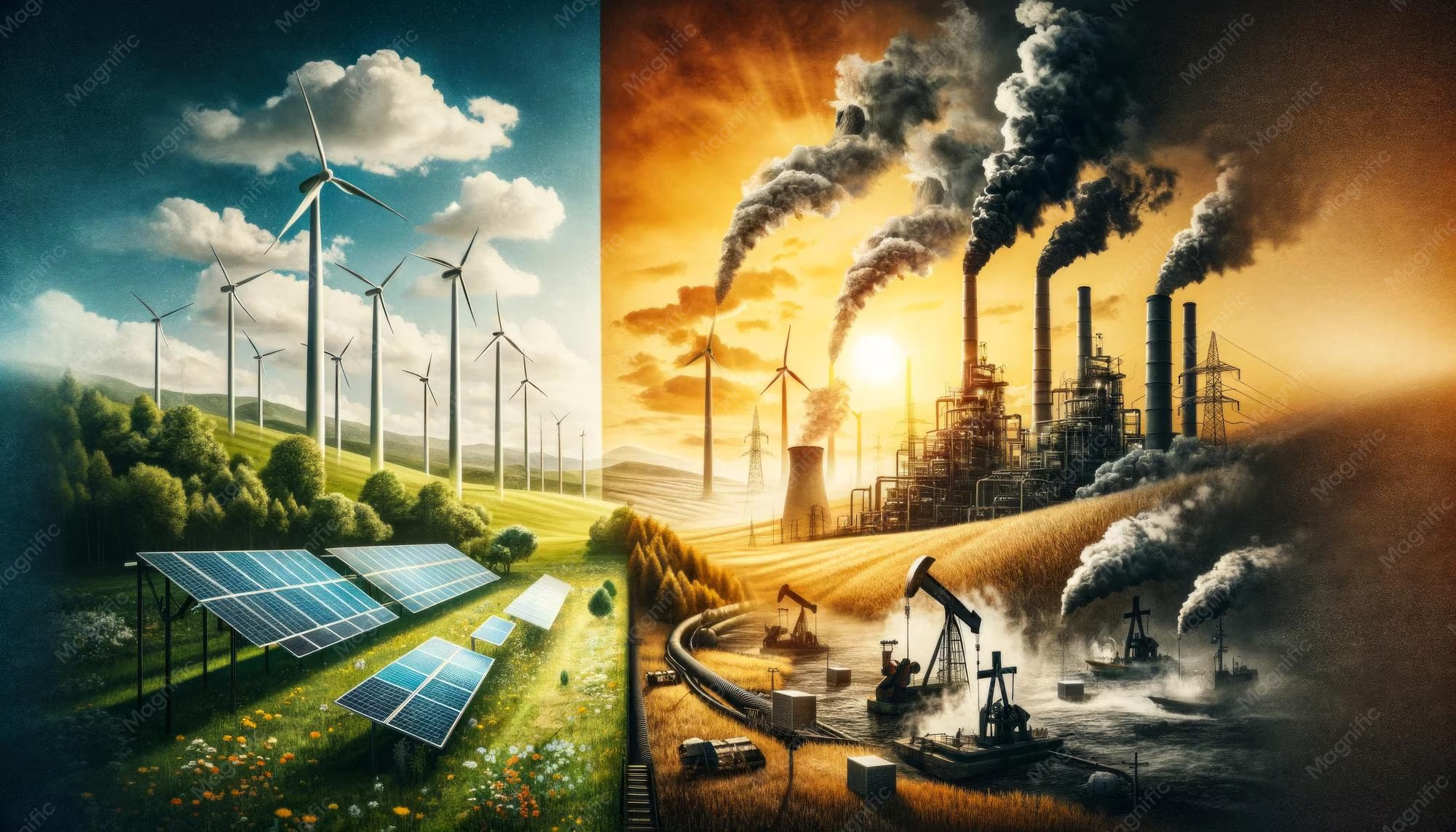
The global energy ecosystem is undergoing a fundamental transformation. For over a century, a select group of multinational corporations built unprecedented economic empires on the extraction, processing, and distribution of hydrocarbons. These fossil fuel empires dictated geopolitical alliances, shaped macroeconomic cycles, and provided the primary base load of global industrial activity. However, an intersection of structural pressures ranging from volatile commodity pricing and strict environmental regulations to breakthroughs in low-carbon technologies has forced these legacy entities to reassess their core business models.
The strategic shift from hydrocarbons to electrons is no longer just a corporate social responsibility initiative; it has evolved into an essential survival strategy. As institutional capital increasingly integrates environmental, social, and governance (ESG) metrics into asset allocation frameworks, oil and gas conglomerates are actively repositioning themselves as diversified energy providers. This comprehensive analysis explores the multifaceted dimensions of this historic transition, evaluating the underlying drivers, corporate strategies, technological investments, and structural hurdles that define the green evolution of traditional energy empires.
Part 1: Structural Catalysts Driving the Low-Carbon Paradigm Shift
The modern reallocation of capital away from upstream hydrocarbon exploration and toward low-carbon infrastructure is propelled by several macro-environmental catalysts. These factors have combined to weaken the long-term risk-adjusted returns of traditional oil and gas projects while simultaneously enhancing the economic viability of utility-scale renewable installations.
A. Regulatory Mandates and Decarbonization Frameworks
Government policies serve as a highly effective external catalyst for corporate restructuring within the energy sector. Binding international agreements, such as the Paris Agreement framework, have forced sovereign nations to implement aggressive net-zero emissions mandates. To fulfill these pledges, regulatory bodies have introduced specific mechanisms that impose direct financial costs on carbon-intensive practices:
-
Carbon Pricing Mechanics: The expansion of compliance carbon markets, such as the European Union Emissions Trading System (EU ETS), effectively internalizes the environmental externalities of oil and gas operations. By assigning a direct financial liability to metric tons of carbon dioxide equivalent ($CO_2e$) emitted, carbon taxation compresses the profit margins of legacy fossil fuel extraction.
-
Subsidies and Tax Incentives: Conversely, legislative packages like the United States Inflation Reduction Act (IRA) offer substantial, long-term fiscal incentives for clean energy production. Production Tax Credits (PTCs) and Investment Tax Credits (ITCs) significantly lower the levelized cost of energy (LCOE) for wind, solar, and clean hydrogen projects, making green investments highly competitive with conventional asset classes.
-
Stricter Methane Mandates: Regulatory frameworks are increasingly targeting short-lived climate pollutants. New international standards enforce strict penalties on upstream flaring and fugitive methane emissions, requiring oil majors to invest heavily in leak detection and repair technologies or face severe financial penalties.
B. The Evolution of Institutional Capital Allocation
The financial architecture backing global industrial activity has shifted its evaluation criteria. Institutional asset managers, sovereign wealth funds, and multilateral development banks are increasingly recognizing that long-term carbon exposure represents an existential financial risk. Consequently, cost-of-capital dynamics have diverged significantly between conventional and renewable energy developments:
-
Premium Pricing on Hydrocarbon Debt: Financial institutions are systematically applying higher risk premiums to debt financing destined for new upstream oil exploration, particularly in unconventional or frontier basins. This trend increases the hurdle rate for conventional projects, requiring higher projected oil prices to justify capital expenditure (CapEx).
-
Green Bond Supremacy: In contrast, the market for green bonds and sustainability-linked loans provides energy enterprises with access to lower-cost capital, provided the proceeds are strictly earmarked for verified low-carbon infrastructure. This financial advantage enables proactive energy firms to optimize their balance sheets by refinancing legacy liabilities through green financial instruments.
-
Shareholder Activism: Institutional equity holders are deploying proxy voting strategies to force corporate boards to adopt verified Science Based Targets (SBTi). Activist investor coalitions have successfully seated independent directors on the boards of major oil conglomerates, shifting corporate mandates toward transparent scope 1, 2, and 3 emissions reduction pathways.
C. Technoeconomic Cost Disinflation in Cleantech
The rapid cost reduction achieved by renewable energy technologies over the past decade has fundamentally disrupted traditional power generation economics. This deflationary trajectory is driven by industrial scaling, supply chain optimization, and iterative engineering advancements:
-
Solar Photovoltaic (PV) Scaling: Wright’s Law—which posits that every doubling of cumulative production yields a fixed percentage reduction in cost—has dramatically optimized solar module manufacturing. The LCOE of utility-scale solar PV has declined to a point where it represents the cheapest source of newly installed electricity across most global jurisdictions.
-
Advanced Energy Storage Systems: The mass commercialization of lithium-ion chemistry, alongside scaling in alternative stationary storage solutions like sodium-ion and iron-flow batteries, is addressing the historic intermittency challenges of wind and solar. Grid-scale battery storage capacity enables renewable assets to capture peak pricing arbitrage, stabilizing revenue streams.
-
Electrification of End-Use Sectors: The rapid adoption of electric vehicles (EVs) and industrial heat pumps is steadily eroding the long-term demand curve for refined petroleum products and natural gas, convincing energy strategists that oil demand will reach a definitive structural plateau.
Part 2: Divergent Diversification Strategies Among Transnational Energy Majors
While the necessity of an energy transition is widely acknowledged across the global corporate landscape, the specific execution models vary considerably by geography, corporate governance, and asset base. Transnational energy majors generally split into two distinct operational ideologies: the European utility-adjacent model and the North American technology-focused mitigation approach.
+-------------------------------------------------------------------------+
|                  STRATEGIC REPOSITIONING ARCHETYPES                      |
+-------------------------------------------------------------------------+
|                                                                         |
|  EUROPEAN ARCHETYPE                     NORTH AMERICAN ARCHETYPE        |
|  (Total Transformation)                 (Hydrocarbon Preservation)      |
|  - Diversified Electrons                - Molecule-Focused Mitigation   |
|  - Utility-scale Wind & Solar           - Carbon Capture & Storage      |
|  - EV Charging Infrastructure           - Enhanced Oil Recovery (EOR)   |
|  - Retail Power Generation              - Blue Hydrogen Production      |
|                                                                         |
+-------------------------------------------------------------------------+
A. The European Model: Total Operational Transformation
European integrated oil majors have pioneered a holistic diversification strategy aimed at transforming themselves into broad-based energy utilities. These companies are actively shifting their long-term value proposition from selling molecules (oil and gas) to selling electrons (electricity).
-
Utility-Scale Renewable Portfolios: European operators have acquired or developed substantial pipelines of offshore wind and utility-scale solar assets. By leveraging their historic experience in managing complex offshore engineering projects, these firms have successfully secured major concessions in deepwater wind farms across the North Sea and the Atlantic.
-
Integrated Power Value Chains: Rather than simply generating renewable power, these enterprises are vertically integrating downstream. They have acquired independent power producers (IPPs), established digital power-trading desks, and entered retail electricity markets, delivering green power directly to industrial and residential consumers.
-
Fleet Electrification and Mobility: To defend their retail fuel margins, European majors are rapidly transforming traditional gas stations into multi-modal mobility hubs equipped with ultra-fast EV charging infrastructure. This strategy leverages premium real estate assets to capture high-margin retail spend while vehicles are charging.
B. The North American Model: Molecule-Focused Mitigation
In contrast, major North American energy corporations have adopted a strategy centered on carbon mitigation and technological adaptation, rather than a wholesale abandonment of hydrocarbons. Their strategy focuses on leveraging engineering core competencies to decarbonize the production and consumption of molecules.
-
Carbon Capture, Utilization, and Storage (CCUS): North American operators are investing heavily in commercial-scale CCUS infrastructure. By capturing $CO_2$ directly from industrial point sources or atmospheric air and injecting it into depleted oil reservoirs or deep saline aquifers, these firms aim to neutralize the emissions profile of conventional energy production.
-
The Hydrogen Economy: These companies are positioning themselves as leaders in the production of low-carbon hydrogen. While prioritizing blue hydrogen (produced from natural gas via steam methane reforming combined with CCUS), they are also building out the supply chains and pipeline infrastructure required to transition to green hydrogen (produced via water electrolysis) as production costs decline.
-
Low-Carbon Liquid Fuels: Rather than abandoning internal combustion architectures, North American strategists are scaling up the production of drop-in renewable fuels. Investments are flowing into renewable diesel, sustainable aviation fuel (SAF), and advanced second-generation biofuels derived from non-food agricultural waste.
Part 3: Technological Foundations of the Modern Green Energy Conglomerate
To execute these strategic pivots, fossil fuel empires are deploying massive capital reserves into a diverse portfolio of emerging technologies. These technical pillars serve as the operational foundation for the next generation of energy conglomerates.
A. Advanced Offshore Wind Infrastructure
Offshore wind represents an ideal technological focus for legacy oil majors due to the direct transferability of maritime engineering capabilities. Constructing and operating multi-megawatt wind turbines in hostile marine environments requires technical competencies originally developed for offshore oil platforms.
-
Fixed-Bottom Foundations: In shallow water environments, companies deploy monopile or jacket foundations anchored directly into the seabed. Engineering innovations focus on maximizing rotor diameters and generator capacities, with modern platforms deploying turbines capable of generating upwards of 15 megawatts per unit.
-
Floating Offshore Wind Platforms: As shallow sites become saturated, energy majors are deploying semi-submersible, spar-buoy, or tension-leg floating platforms. These technologies unlock deepwater wind resources located far offshore, where wind profiles are stronger and more consistent, utilizing mooring and tethering methodologies derived from deepwater oil drilling.
-
High-Voltage Direct Current (HVDC) Transmission: Because offshore wind farms are frequently located hundreds of miles from coastal demand centers, conventional alternating current (AC) transmission suffers from unsustainable transmission losses. Energy conglomerates are deploying utility-scale HVDC converter platforms to efficiently transmit power over long distances via subsea cables.
B. Carbon Management and Geologic Sequestration
For organizations pursuing molecule-focused mitigation, mastering the carbon management value chain is an absolute technical requirement. This process involves capturing, transporting, and permanently isolating carbon dioxide from the active biosphere.
-
Chemical Absorption Systems: Post-combustion carbon capture utilizes advanced liquid amine solvents to selectively bind with $CO_2$ from flue gases. Once saturated, the solvent is thermally regenerated, yielding a high-purity $CO_2$ stream ready for compression and transport.
-
Direct Air Capture (DAC): The frontier of carbon mitigation involves solid-sorbent or liquid-aqueous systems engineered to extract ambient carbon dioxide directly from the atmosphere. While historically energy-intensive, energy firms are co-locating DAC plants with low-cost geothermal or stranded solar assets to optimize operational efficiency.
-
Deep Saline Aquifer Disposal: Permanent storage requires injecting compressed, supercritical $CO_2$ into deeply buried, porous sedimentary formations sealed by impermeable caprock layers. Advanced seismic monitoring, reservoir modeling, and pressure management systems are deployed to ensure the long-term structural integrity of the storage formation, preventing leakage back into the atmosphere or shallow freshwater aquifers.
C. Next-Generation Geothermal Systems
Geothermal energy represents a critical bridge technology for fossil fuel enterprises, as it relies on deep drilling, reservoir engineering, and subsurface thermodynamic analysis—the exact skill sets found within upstream petroleum engineering teams.
-
Enhanced Geothermal Systems (EGS): Traditional geothermal is limited to regions with naturally occurring hydrothermal reservoirs. EGS technology bypasses this geographic constraint by drilling into hot, impermeable basement rock and creating artificial permeability through hydraulic stimulation, enabling fluid circulation to extract thermal energy.
-
Advanced Geothermal Systems (AGS): Also known as closed-loop geothermal, AGS utilizes deep, engineered sub-surface heat exchangers that circulate working fluids through a sealed network of lateral boreholes. This approach eliminates the need for fluid extraction or fracking, harvesting heat solely through conduction.
-
Supercritical Geothermal Generation: By drilling deep enough to access ultra-deep rock formations where ambient temperatures exceed 400°C, operators aim to harvest fluid in a supercritical state. Supercritical fluid carries substantially higher energy density per unit of mass, exponentially increasing the electrical output per wellhead compared to conventional geothermal assets.
Part 4: Critical Obstacles and Structural Headwinds Inhibiting the Transition
The transition from a carbon-reliant business model to a sustainable energy framework is highly complex. Fossil fuel empires face a series of deep-seated financial, operational, and structural bottlenecks that threaten to slow or disrupt their diversification efforts.
+-------------------------------------------------------------------------+
|                  ENERGY TRANSITION STRUCTURAL BARRIERS                  |
+-------------------------------------------------------------------------+
|                                                                         |
|  FINANCIAL HURDLES           OPERATIONAL BOTTLENECKS  CULTURE & LEGACY  |
|  - Margin Compression        - Grid Interconnection   - Asset Stranding |
|  - Dividend Commitments      - Supply Chain Shock     - Skill Misalignment|
|  - Volatile Returns          - Permitting Delays      - Institutional Inertia|
|                                                                         |
+-------------------------------------------------------------------------+
A. Financial Disparities and Margin Compression
The core economic challenge of the energy transition centers on capital efficiency and return profiles. Historically, successful upstream oil and gas projects delivered double-digit internal rates of return (IRRs), often ranging from 15% to 25% during high-commodity-price environments.
-
Compressed Renewable IRRs: Regulated or contracted utility-scale solar and wind projects traditionally yield stable, infrastructure-like IRRs, typically between 6% and 9%. Corporate financial officers face the difficult task of convincing equity markets to support massive capital reallocations toward asset classes that offer lower near-term returns, even if those returns are lower-risk and more predictable.
-
The Burden of Dividend Commitments: Traditional oil majors are favored by institutional income investors due to their reliable, high-yield dividend payouts. Maintaining these massive capital distributions leaves less free cash flow available to fund the intensive capital investments required to build out multi-gigawatt clean energy portfolios.
-
Commodity Price Volatility Cycles: Periods of high oil and gas prices generate massive short-term cash windfalls from conventional upstream assets. These spikes can reduce corporate urgency for diversification, leading boards to face internal friction regarding whether to accelerate green capital expenditures or return capital to shareholders via stock buybacks.
B. Grid Constraints, Interconnection, and Infrastructure Bottlenecks
Building green generation capacity is meaningless without the physical transmission infrastructure required to move electricity from remote generation sites to urban demand centers.
-
Interconnection Queue Backlogs: Across Europe and North America, grid operators are overwhelmed by interconnection requests. Renewable projects developed by energy majors often wait years for technical review and grid reinforcement, delaying commercial operation and dragging down project economics.
-
Transmission Capacity Degradation: The modern electrical grid was structurally designed for a centralized model, where large fossil-fuel or nuclear baseload plants sat close to population centers. Integrating decentralized, remote renewable resources requires trillions of dollars in new high-voltage transmission infrastructure, a challenge that requires significant public-private coordination.
-
Supply Chain Vulnerabilities and Critical Minerals: The clean energy value chain is highly dependent on specialized raw materials, including polysilicon, lithium, cobalt, nickel, and rare-earth elements required for wind turbine permanent magnets. Geopolitical tensions, trade barriers, and mining capacity constraints introduce severe supply chain risks that can delay construction timelines and drive up project costs.
C. Organizational Inertia and Legacy Asset Stranding
Transforming a corporate culture optimized for hydrocarbon extraction into one designed for digital power management and clean technology innovation presents a major leadership challenge.
-
Subsurface vs. Surface Expertise: Upstream oil companies employ thousands of petroleum engineers, geophysicists, and mud loggers whose hyper-specialized expertise does not automatically translate to designing solar arrays or managing battery storage software systems. Managing this human capital transition requires extensive retraining or expensive corporate acquisitions.
-
The Threat of Stranded Capital: Energy majors carry billions of dollars in unamortized conventional assets on their balance sheets, including refineries, deepwater platforms, and pipeline networks. Accelerating the transition requires writing down these assets ahead of their accounting lifecycles, which can trigger significant balance-sheet adjustments and negative reactions from equity markets.
Part 5: The Strategic Path Forward for Emerging Green Titans
To successfully navigate this transitional era, emerging energy titans must construct balanced portfolios that pair immediate financial sustainability with long-term carbon neutrality. The final phase of corporate transformation requires adopting an integrated, agile approach to global asset management.
A. Implementing Capital Allocation Frameworks
Energy conglomerates must establish clear capital allocation frameworks that balance funding for legacy core assets with scaling investments in clean technologies:
-
Tactical Harvesting of Hydrocarbon Rents: Companies should operate their existing high-margin upstream hydrocarbon assets with strict capital discipline, utilizing the cash flows generated by conventional assets to directly capitalize low-carbon business lines.
-
Rigorous Risk-Adjusted Evaluation: Firms should apply differentiated hurdle rates to capital requests, acknowledging the lower risk and predictable cash flows of contracted renewable generation compared to high-risk upstream exploratory drilling.
-
Phased Milestones: Capital deployment into speculative green technologies like green hydrogen or direct air capture should be tied to clear commercialization milestones, scaling up only as the underlying technologies hit specific cost-reduction targets.
B. Forging Strategic Ecosystem Partnerships
No individual corporation can master the entire breadth of the global energy transition alone. Forward-thinking companies are forming strategic alliances across industries to de-risk their expansion plans:
-
Collaborations with Technology Providers: Energy firms are partnering with technology enterprises to deploy artificial intelligence and machine-learning models optimized for real-time power grid management, predictive asset maintenance, and automated battery arbitrage trading.
-
Industrial Co-Location Alliances: Companies are designing integrated industrial parks where chemical manufacturing, steel production, or heavy logistics hubs are directly co-located with carbon capture networks and hydrogen production facilities, minimizing transportation and distribution losses.
-
Academic and Venture Ecosystem Integration: Energy majors are deploying corporate venture capital arms to fund early-stage cleantech startups, securing early access to disruptive technologies like solid-state batteries, advanced nuclear designs, and synthetic e-fuels.
This strategic re-engineering of global energy conglomerates represents a defining shift for modern industrial society. By systematically deploying their capital, engineering expertise, and project management capabilities toward low-carbon solutions, these historic fossil fuel empires are reshaping themselves to survive and potentially lead the clean energy economy of tomorrow.
Recommended Video Resource
For a detailed analysis of how corporate finance and energy policy intersect during this energy transition, view the Clean Energy Transition Investment Forum Panel. This recording offers expert perspectives from European public authorities, financial institutions, and industry executives discussing actionable pathways and real projects aimed at financing clean energy deployment.